When I was little, I was obsessed with those word games in the Highlights magazine. Match the words up to their definitions, find the hidden words in the puzzle or the picture.
I remember being glued to the TV, PBS in particular, watching Levar Burton walk me through book after book on his Reading Rainbow. Knowing that I could fly anywhere if I took a look because it’s in a book.
All of those pizza hut book-it awards that I kept, on bright yellow paper. One personal pan sized pizza for reading a bazillion books. It was always worth it.
Hearing my future husband put words together. Like when he described our cat as a mental giant. Or the bits and bobs left behind as we moved in together. Or the time he read to me when I couldn’t sleep because I was too nauseous.
When I got sick and found that writing was a balm, a piece of satin that wrapped around me. so comforting and a source of meaning. I found my pain and in that I found my voice.
Hearing that my Dad is so good with words. A poet. A lyricist. His toast at our wedding. Playing with words, keeping us on the edge of our seats with stories.
And now, I cannot get enough words. Words from those people who are different than me. Expanding my universe at a rapid rate. Uncovering whole new universes I was missing. Giving that much more texture to the human experience, to the parts that are unique and the parts that are shared. Believing those words of lives and living that have been alongside me all along.
I don’t know what happens when we die, if anything happens. And here’s the thing, I won’t know until it happens, or doesn’t happen.
But I now understand what becomes of the physical remains of a body, what the iterations and generations of the world’s religions mean when they say, “ashes to ashes, dust to dust.”
Because that’s my Dad. He’s dust. His cremains, now in some boxes, a carved study oak one, a simple bamboo canister, a tiny vessel that I can fit in my pocket. And from the crematorium into the atmosphere too, no doubt. The iron and sodium and magnesium and calcium and all the things that made his cells sing until they went quiet. They are still here. In the dust, traveling and settling and getting kicked up again to be on the move.
I think it’s true that matter is not created nor destroyed. At least that is how I’m sleeping at night.
So, maybe, my Dad is the dust that was on my hiking books, when we descended into Glen Canyon on this wretchedly hot and stifling weekend, determined that the “unhealthy for some” air quality exempted us, and, in particular, me. I needed to show them that I’m fine in every way. I’m tough. I got this. I was not fine, as the dust in the air that filled my lungs – even through the breaths I took with the mask on – made me wonder what it was like to suffocate.
Or perhaps my Dad was in the piles of paper I’ve been going through, my pandemic project. Every scrap of paper, it seems, that’s passed through my hands to my grandparents or to my parents. Letters, artwork, pictures, memories, the story of my life out of any logical sequence. Stuffed sideways into boxes. A note home about my college boyfriend and the trouble we were having. My first-grade report card. My favorite picture of my Aunt Lula Mae in a fur coat with her cat eye glasses. My grandma GG’s lasagna recipe. I breathed them in, each one, over these last six months, the layers of dust and the smells of places far away and vivid pictures in my mind that accompany me. Maybe I was breathing in my Dad.
Maybe my Dad is mixed with the dust of fires. Dust that now resides high up in the atmosphere above San Francisco making the sun red. The dust of the floor boards, the bedframes, insulation, wedding pictures, dishes, tennis shoes. The dust of forests, brittle leaves, delicate branches, dense underbrush, soil. The dust of the small animals and the big animals. The dust of other bodies.
I wonder if he’s lonely and if he misses us.
I breathe in and I breathe him in.
He’s with me wherever I go, and when I go again, I’ll bring him to the corners of the earth if I don’t already find him there.
I’ve become obsessed with my family tree. I guess that’s what happens when one branch of it, the sturdy branch below me, breaks off, drops down while disappearing into thin air, leaving only traces of DNA in my brothers and me.
But why am I telling you this?
In many ways, cheese has been a constant presence, my world turner. Those reasonably-priced Velveeta cheese bricks in aluminum foil when times were tight. The lasagna my grandma GG made fancy when she added in cottage cheese. The first time I had sheep’s milk cheese, in graduate school, on a date with a serial cheater. When I let the truffle tremor melt in my mouth, while sitting and staring at the golden gate bridge, knowing I had found a new home. The career change I contemplated, still am, forever will be, thinking about the goat farm in southern Illinois that is begging to be birthed, the goats I had next door growing up helping break me in to what a life with a herd of odd little animals with horizontal pupils and cocked heads could be like, the raw milk I could drink daily. All those niche San Francisco cheese classes I’ve taken, 12 cheeses a class times ten classes is at least 120 unique cheeses. So much cheese, so little time. The solid dinners I’ve assembled on weeknights of a special aged gouda, apple slices and almonds. I’ve been on cheese tours and to cheese festivals and have smuggled cheese back from every animal – camel, yak, cow, sheep, goat – and every corner of the world every chance I could get, dodging US Customs and Border Patrol and their sniffing beagles near the luggage carousels. I dream about cheese.
So back to my family tree. You can understand the jolt that shimmered through my body, not once but twice, when I identified my great great grandma’s last name was Kaeseman. German for cheese man.
And then when I learned my great grandpa Calcari was a sheep herder in the Dolomites, in those rich Calcareous hills, before running away to America. His consistent snack – from stories passed down – was a wheel of hardened sheep’s milk cheese to keep him warm in the chilly alpine mornings.
I can sit here, dreaming about this family tree, trying to make meaning of it, like those tributaries of tree branches are pointing one direction, gently guiding me to my destiny, a marriage with cheese.
I think perhaps the knowing is simply enough, as long as it comes with an incredible cheese plate.
The house had sat vacant for nearly three months. Old, still, silent.
We had to clear a spider web from the steps to even walk up to the front door. There were puddles of gnats in random places throughout the house. Cobwebs in corners, and spider eggs in the skylights. The musty smell, shut tight, curtains drawn, dust settled.
We threw on a faucet, and then the washing machine. We rebooted the house alarm and reset the clock on the microwave. We discovered some spikey pieces of beets in the fridge that had withered away to wisps. And two rotten lemons spreading soft mold on the counter. The leaves of the plants we left behind, surrounding the pots like halos on the ground.
And then we started to scrub and mist and cleanse and vacuum and mop. Yet it was as if the dirt was multiplying as we went. But focusing on this was the only control I could get in this pandemic racist world full of death and suffering.
Hours of this passed. It was getting late, the jet lag didn’t bother us if we kept moving though. And then I saw it, under the sink, deep in the corner – a tail, maggots, a mouse trap gone off. My adrenaline shot up. I raced to check the other traps and discovered another mouse, who knows how long he had been gone either.
Neither one of them a good candidate for survival.
I’ve been waiting, waiting for a sign, waiting for a saving grace, waiting for a moment. There are so many ways to wait.
When my mom and dad were young, before the three of us kids came into their lives, my dad coached football, sometimes long into the autumn evenings. Mom would sit there, in the big bay window overlooking the side yard and driveway, the train tracks and horizons of dried out corn stalks, and peel a pomegranate. Crimson red, aril by aril. She’d wait for him, for the headlights to shine over the 1900s farmhouse and his safe return.
The fig tree we planted in our backyard when I first got sick continues to struggle – bearing no fruit. I’m still waiting. I planted that tree with a vision in mind. The mutual relationship that certain wasps have with certain figs, a reliance on each other, a perfect synchronicity. When the figs need to be pollinated, they put an invitation in the air, a scent, and then they wait. The first of many female wasps comes in, crawls in the tiny hole of the bud, and spreads the pollen from where she was born to fertilize the figs. This mother wasps loses some of her wings and her antennae in the act of love and hope for the future. She couldn’t leave the fig now if she tried, so she lays her eggs in this fig. This is her last act before she dies. The wasps hatch and mate – the male wasps then die and females leave the bloom to go fertilize other figs. I’m waiting for these figs, so I can crack them open and see all the dozens of tiny flowers and know how they got to be here.
Last year, I shared a fig with a person from the Saami Indigenous community, from northern Sweden. Surely by now in that part of the hemisphere, the light is angling darker, while the figs here in northern California are coming into their own. The trees branches lolling with the blessing of fruit. The Saami have at least 8 seasons in their years. It’s autumn-summer for them now. Not quite summer and not quite autumn. I wonder what they are waiting for in this liminal time, the space in between for us all, the then and now.
The pomegranate, the figs, the fruits of a womb and of a death. Are they the sign I need? The saving grace? Is this the moment I’ve been waiting for?
I feel like a wrung out rag. Like that dirty cloth my Dad kept in the garage, with various stripes of residue from an engine, or an oil change, or from wiping down the cabinets filled with random screws from long ago projects, abandoned bungee cords, assorted zip ties, and antique wrench sets.
That rag has seen better days. We all have.
The last two hours I’ve sat here, as a therapist who is not a trained therapist. Listening to her story. Cancer, young, might die, might not. I’m warm but distanced, wet with tears that don’t fall, and poised but crumpled.
Why is August diagnosis season?
Why does August go on so long – the month that stretches out the blooms of summer, their sweet petals giving us a sense of endlessness, before the air turns crisp and the smell of death, decay and dying turns up, yet again?
I didn’t know life after death would have so much dessert.
My dad became the sweet tooth in the Calcari family, starting after his open heart surgery and continuing through his decade-long journey with cancer. We tried, begged, bargained to get more vegetables and protein into his diet. It was our little sphere of influence to try and keep him on this planet for even a day longer.
He was patient with us, listening, nodding. And then he would firmly push those things aside and swing by BK Bakery to get a cannoli. Or a morning bun from Blackbird Bakery. Or a cream-filled donut from Little Taste of Heaven. He had every bakery within a 20-mile radius wrapped around his finger. Maybe they knew an easy target, or maybe they loved his stories, or maybe they realize he made them feel like they mattered. Each hospital stay, and there were many – for the femur replacement, for the spinal fusion, and then another spinal fusion, for the numerous times fluid needed to be drained from his lungs, for the observations – friend after friend would parade through his room to deliver him some fantastic box of treats. And he would smile his wide, gap-toothed grin, throwing it my way or my mom’s way, as if to say, “look at me, breaking all the rules!”
When Dad entered hospice, we kept trying to do what we do. Food is our family’s love language, as if nutrition mattered at this point.
Dad ate less and less, lighting up most when we offered sweeter options like homemade whole milk tapioca pudding. When we were getting desperate, the nurse let us know that she has really good luck with her patients eating ice cream. So, we settled into a full week of Dad trying his hand at cookies and cream, vanilla bean, and his favorite old-fashioned hand-churned black cherry. We left no stone unturned in the Bill’s IGA freezer aisle.
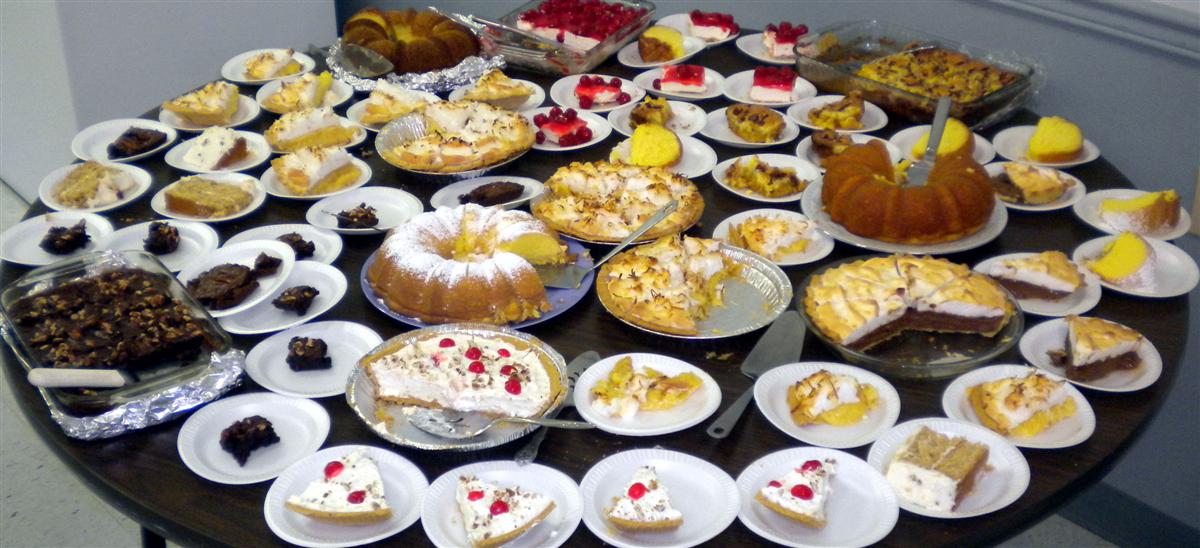
So when Dad died, the small town heroics began. The Midwest representing. The procession of sugar, the pageantry of Duncan Hines, as if a motorcade of desserts would bring us comfort, would bring our Dad back.
The poke cake with jello, and a can of cherry pie filling on top, because cake plus jello plus whipped cream is not sweet enough.
A warm apple pie
A warm cherry pie
Pina colada cake with whipped cream and shaved coconut, delivered in an embroidered carrying case
Brownies straight up
Brownies with extra chocolate chips and nuts
Blondies, brought over still warm
Rhubarb nut bread
Chocolate chip cookies
Coffee cake stuck in the old beer crate on the porch without a note
Reliable rice krispies
Cannolis and cream horns
Chocolate-covered strawberries
Cinnamon rolls drizzled with chunky applesauce
Zucchini bread
Banana cream pie, surprisingly, with the banana on the side
An inaptly-named fruit salad, with the only fruit being grapes and apples cut up and mixed with marshmallow fluff and whipped cream
Angel food cake, with a noted three extra egg whites to make it tall
And, a peaches and cream pie.
And, we haven’t touched any of them. They sit, stacked and staring at us. Getting cold, going stale, preparing themselves for the birds or the trashcan. All that love, waiting to be received.
I wish Dad was here, because I would finally give in and make him the plate he always wanted.
It’s about knowing the odds are against you but tying up your shoelaces and getting into the game. It’s about taking on life with zest and curiosity. It’s about making others feel important, seeing the talent in everyone, no matter how rambunctious or wayward we might be. It’s about a wink and a smile. It’s about never meeting a stranger. It’s about striving with incredibly hard work and creativity in making ends meet. It’s about how to be a servant leader. It’s about situating yourself in an incredible community with tender-hearted, generous friends who are here with us today. It’s about direct instructions, to “not foul out” or “always follow through.” It’s about discovering new ways to delight each day in our mom’s company and keep building on 58 years together. It’s about expecting a miracle.
Like any person, Dad held many things at once.
He was playful and he was fierce.
He was stern and he was soft.
He wore his heart on his sleeve and he grieved privately.
He was carefree and he cared about everything.
He tended to tools and machines with the same hands he cradled bunnies, birds, and kittens.
He rolled homemade gnocchi out by hand and he added Stovetop stuffing to his Thanksgiving dressing (his little secret).
He pulled weeds and he picked flowers.
He toiled so hard and he relished everything.
He was a character and a man of character.
Dad was, consistently, without contradiction, someone who eked everything out of this life. He could savor an M&M for 10 minutes (we timed it), he enjoyed TV commercials never fast-forwarding, he loved a long road trip, he read each word in the newspaper, he floated on his back in the ocean for hours, he toured the backyard caring for plants well into an evening, and he walked every aisle at Bill’s IGA over again. He wanted to hear about everything, especially from his four precious granddaughters, and his kids and his in-law kids who he loved like his own.
In the last few months of his life, Dad asked us whether he taught us right from wrong and how to get involved in making the world – however big or small our world may be – better than how we found it. And He did. He taught us moral clarity and encouraged conviction in everything we do. And he did it with humor. I told him this month that I was reading a poem by e.e. cummings that reminded me of him, saying, ‘I carry your heart, I carry it in my heart.’ and Dad responded, with a grin, ‘I carry your heart, I carry it in my fart.’” Dad could never have enough laughter.
It feels right to celebrate him today, on Father’s Day weekend.
As Dad said, he’s just ahead of us and will see us soon enough. And he’ll have the Stag beer box full.
We know that to be with our Dad is to have an adventure. So here’s to your next adventure, Dad.
We love you. You are the brightest star in our sky.
Last summer, my mom made the decision – on behalf of the entire house – to not put the hanging ferns up on the wraparound porch, home to generations of red finches. She said, “The birds, they’re noisy and poop everywhere, and I can’t water the ferns while they build their nests. And when we leave on vacation, the ferns die anyway.”
This was the first time in my memory that the spots for those delicate ferns, their fronds draping down towards the ground, would be bare. But I understood. Her decision an exasperation or maybe a defiance of what else was unfolding inside the house.
This summer was different though. Between a raging pandemic and Dad going into hospice, plans changed. The week I got to my childhood home, the week I wondered aloud, “what do you pack in a pandemic when you’re going to see your dad die?”, the week I realized what the passage of time means – this was the week three ferns were hung in their rightful place. I don’t know who put them there, come to think of it.
When my dad was resting, and the air was too thick inside the house, the buzz of too many adults in caretaking roles becoming too strong, when I wanted an escape, I would head to the porch. The white wicker furniture, wide ottoman, red brick my Grandpa Pop masoned, old wooden beer crate hiding the gardening gloves and citronella candles. I would stretch out with my computer on my lap, my mind escaping into a compartment. The freight trains would come and go on a schedule that’s as predictable as breath. I’d pause to wonder where that oil and coal and graffiti was headed, maybe north to Chicago or south to New Orleans. When the air was heavy with humidity, the train horn and railroad track jingles were that much louder. The water droplets held and stretched out the sound, bending and extending time. We all wanted more time.
And then I saw them. Finally. All the other signs of spring were on schedule – the jonquils, whirly gigs and helicopters from the Japanese maple and the sugar maple, the sweet gumballs and delicate blue robin’s egg shell parts scattered on the sidewalk. But I had still been waiting for these pairs to mark their arrival. The red finch, also aptly called the house finch. Species name Haemorhous mexicanus. They mate for years and live for years, making those couple of ounces of feathers and bones last many journeys north and many journeys south. Flying on desire, an internal timeline, the angle of the sun, the temperature of the ground. Their long, twittering song, I close my eyes and can hear it in my mind.
And there were three pairs. One for each of the ferns. In between these stretches of caregiving and conference calls, I would sit and watch the birds as they hustled. Flew out of the ferns, dipped to the ground before they picked up air and speed, only to gracefully land in the oak or on the weather vane or the Cleveland pears, maybe looking back at me and sensing the urgency of time we were up against, taking a breath before flying off again. Sometimes it seemed like they were arguing over which nest site was the best. The pairs, the male a bold red and the female mottled. Zipping to and fro with twigs and dried grass, a loose piece of red string, even a strand of creeping jenny. It took them two days to build their nests, tucked away in the ferns. Their nests perfect circles. So perfect I had to look twice. What is this miracle, from the green earth and bird spit, of a 360-degree nest? I couldn’t wait to tell my dad. He grinned widely, eyes closed.
The next day, five eggs appeared in the first fern. Their color a gentle sky blue, almost white, like the sky in the midday sun. And one speckled brown. Maybe it would be a cowbird egg, the brood parasite bird. Sneaking in to lay its egg and have the finch do all the raising and rearing. Time would tell, as it would everything else.
Two weeks went by and I heard them – five fuzzy babies.
I peered in, and the birds blinked at me, suddenly quiet and still. I stepped away, not wanting to interfere further with the nature of things.
The parents came back and forth to the nest like frenetic creatures keeping pace with the extra minutes of sunlight each day. When I’d walk out the back door, they would zip away, even when I tiptoed. And once I settled back in my own perch on the wicker chair, the parents would timidly return. Doing laps around the yard, bringing all the right things to make these five chicks go wild, saying “Feed me! Feed me! Feed me first!”
My co-worker, after hearing the constant birdsong over our many zoom connections said, “I just love those birds.” I did too.
The outside world and these finches continued on their path of birth and growth, while the inside world subtly inched towards an ending.
It was June 13. A temperate spring day in the lower Midwest, the smell of cut grass and damp earth like a cloak, a homecoming. The day my dad took his last breath.
In the ten years of his diagnosis, countless hospital stays and procedures and infusions, we all worked to leave no stone unturned, with his life, with our words. I truly thought that I had said all the things I possibly say could to him, that he knew how I felt and I knew how he felt, and that was enough.
As his last day approached, he spoke his final words to my niece, “I love you.” He had spent a night wanting my mom to hold him, and she did. He squeezed our hands as we gently massaged his. Single tears rolled down his cheeks that we wiped away into our own. Then the struggle and process began, of a soul separating from a body. We do not go easy from this world.
All family around all day at his bedside, working to normalize death, understand that the rattle was a body coming to its end, that comfort and grace were gifts.
And then, it was silent.
There is no preparing, no matter how much we rationalize it. Shock and grief, like looking into a well so deep the bottom isn’t visible. There’s only disappearing darkness. Realizing that when it comes to time, where there is love, it’s never enough.
My mom, brothers, sisters-in-law, husband, nieces, and family friends were in and out of the bedroom. We told stories, we held my dad, we cried, we acted as though this was something that we do everyday. When my nieces hit a saturation point, of the tears and stillness of someone’s body, they would remove themselves and go outside to get air. I followed after one of them suggested that we should go check on the birds.
I gently lowered the fern with the five babies, more feathers than fuzz now.
And they all flew, every single one. One directly up into the study oak, others nearly missing a pillar on the porch and skimming the grass before ascending off and on into the evening.
We waited, still, and the birds never returned to the nest. It was complete.
My first instinct was that I couldn’t wait to tell my dad, that he would be so tickled and warmed at the thought of another red finch brood successfully on their way.
I caught my breath when I realized, in a ball of sadness, that there is more to be said to one another, always.
Love is savoring one M&M for minutes. Reaching into the porcelain bowl by his bed and choosing which color matches the mood. Today is blue.
Love is the pleasing impact when the hard shell crunches and shatters, with slight pressure, once it breaks open, dissolving, making way for the chocolate, that heats up and melts, spreading its goodness, rolling itself over all the ridges, like velvet feels or a river does.
The more still he is, the deeper his breath, the longer it lasts.
Love is knowing that there might not be more M&Ms. That all that we have is now, this meditation, this breath, this tether of a treat holding us in time.
Love is knowing that this is a skill that my dad has mastered. How to stretch time. How to create something from near nothing. And forever a teacher, this is one of his final lessons for me.
Love is that the taste of morphine and haloperidol and oxy and Ativan and all of the other things that we keep syringing in him for comfort, that the only thing that seems to wash them down is a single M&M.
Love is just one. Working on it, until it’s a tiny spec on the tongue, almost as small as a tastebud that is all lit up from an experience, a life, a thing that reminds us that it’s still here, working hard, translating pleasure from one sense to the next, like a baton of joy, finishing the race, seeing the finish line, or is it the starting line.
What happens though, when he can no longer swallow?
What happens though, when he can no longer breathe?




 keeping abreast | keeping a breast